
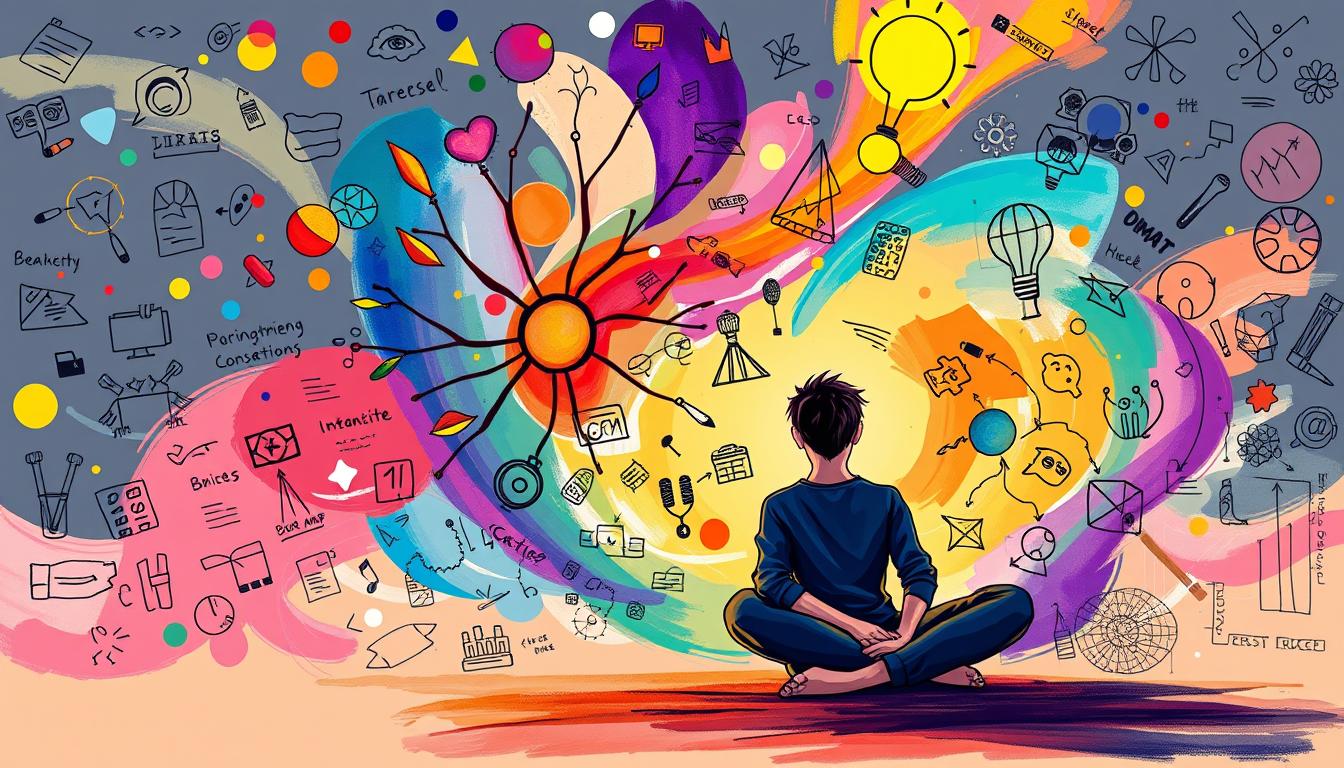
Creativity isn’t just for artists. It’s a skill anyone can learn. Many people face creative blocks that stop them from reaching their full ability. But, science shows even small changes can unlock our creative power.
Walking, for example, is more creative than sitting, a 2014 study found. Even a short walk outside can spark new ideas.
Being in nature also boosts creativity. A University of Utah study showed hikers were 50% more creative after four days in the wilderness. Simple changes like moving, changing your space, or embracing boredom can start the creative process.
Boredom can actually help us think outside the box. It pushes us to find new solutions when we’re stuck in a routine.
To unlock your creative power, try reimagining problems. Research from Rider University found that setting time limits or specific tasks, like making rhyming phrases, can spark creativity. This section will show how daily habits like exercise or mindfulness can sharpen your focus and lead to new ideas.
Understanding How Your Mind Blocks Creativity
“Many of you don’t live a limitless life… When we’re born we’re free. Society, culture, and schools teach us how to think. They restrict our thinking and place a limiting valve on our consciousness.”
Subconscious limitations often start early. Schools focus on “correct” answers, stifling curiosity. Research shows 70% of creative thinkers feel trapped by societal expectations.
These expectations shape mental blocks to creativity, stopping ideas before they start. Fear of failure is another barrier. Thomas Edison’s 1,000 failed attempts at the light bulb show the importance of persistence.
Ambiguity boosts innovation, yet it scares many. Playful thinking, like brainstorming without rules, sparks unique ideas. Groupthink reduces innovation by 30%, while blue enhances divergent thinking.
Even boredom helps—daydreaming lets minds wander freely. Notice patterns in your thinking. Do you dismiss ideas too soon? Or worry others will judge?
These habits create mental blocks. Awareness is the first step. Small shifts, like walking while thinking or visiting museums, can reset perspectives. Start by naming your creative barriers. Every step forward starts with seeing what holds you back.
The Powerful Connection Between Your Subconscious and Creativity
Subconscious creativity comes from the creative mind’s hidden power. While you focus on everyday tasks, your subconscious is hard at work. It holds patterns and connections your logical mind might miss.
Neuroscientists like Dr. Marcus Raichle found the default mode network (DMN). This network is active when you rest. It links memories, ideas, and experiences, sparking new insights.

When you’re stuck, taking a break can help. Your subconscious keeps working, even when you’re not paying attention. For example, James Watson and Francis Crick’s DNA discovery came after months of subconscious work.
Leonardo da Vinci combined art and science by tapping into his subconscious. Simple activities like daydreaming or walking let the DMN create. This boosts subconscious creativity.
Studies show relaxed states enhance creative thinking. Morning pages, as Julia Cameron suggests, help reveal subconscious ideas. Thomas Edison also used a drowsy state to find new ideas. Understanding your subconscious can make creativity a team effort between your conscious and subconscious.
The One-Step Solution: Mindful Awareness Practice
Mindful awareness is more than meditation. It’s a boost creativity practice that unlocks your inner talent. By watching your thoughts without judgment, you remove mental blocks that stop your creativity. Studies show kids who practice this way score better on creativity tests, showing it works for anyone.
Begin with just 5 minutes a day. Sit comfortably, focus on your breath, and observe your thoughts without getting caught up in them. This creative mindfulness helps your brain accept new ideas. Companies like Walt Disney and General Mills saw their teams come up with more innovative ideas after starting these practices.
So, why does it work? Mindful awareness makes your brain more flexible, allowing you to see things from different angles and find unique solutions. Research shows it also lowers stress, letting you explore without fear. Even short sessions can change your brain to spot patterns others miss.
Having trouble staying focused? Start with guided apps or short breathing exercises. Over time, this practice becomes a quick creativity boost, ready to spark ideas whenever you need them. Remember, creativity grows in calm, open minds. Try it today and see what amazing ideas come out.
Unleashing Creativity Through Mind Mapping Techniques
Unlock your mind mapping creativity with visual thinking techniques. These methods turn scattered ideas into organized brilliance. It’s not just for artists—anyone can use mind maps to boost creative brainstorming.
Start by placing your central idea at the center. Then, branch out with keywords, images, and colors. Combining words and visuals activates both sides of the brain. This sparks connections that linear notes can’t match.
Studies show mind mapping improves retention by up to 15% compared to traditional methods. Apps like MindMeister or Xmind make it easy to create digital maps. Miro offers real-time collaboration for teams.
Use bold colors and icons to highlight key concepts. This visual stimulation keeps your mind engaged and open to innovative solutions.

Even if you’re not “visual,” try it: draw rough shapes or scribbles on paper first. The act of mapping itself stimulates creative visualization. It helps you see patterns and possibilities you’d miss in a list.
Whether planning a project or solving a problem, mind maps transform confusion into clarity. Ready to try? Grab a pen or open an app—your next big idea is just a branch away!
Breaking Free from Mind Traps That Limit Your Creativity
Creativity mind traps like perfectionism and fear of judgment can really hold you back. Up to 70% of people think they’re not creative, but that’s just a belief. Think of Babe Ruth, who hit 714 home runs but also struck out 1,330 times. He knew that mistakes were part of the journey.
To overcome creative blocks, ask yourself: *What if I tried?* Often, we let others’ opinions stop us. But, studies show that challenging these thoughts can boost problem-solving by 50%. Start by writing down one “bad idea” each day. Many great ideas started as rough drafts.
“The only way to do great work is to love what you do.” – Steve Jobs
Fear of failure is a big reason for creative hesitation, affecting 60% of people. To break free, see every idea as a step, not the final goal. Artists who write down their doubts see a 45% increase in creative flow. Remember, too much analysis can stop you. Act first, refine later.
Change negative thoughts like *I can’t* to *What if I?* This can change your mindset over time. Creativity grows in places where mistakes teach, not fail. Your mind is full of possibilities—start breaking free today.
Journaling Exercises to Quickly Stimulate Creative Thinking
Unlock your creative side with creative journaling. It turns empty pages into places for new ideas. Studies show that writing for creativity boosts brain areas for solving problems and thinking outside the box. Just five minutes a day can help break through mental barriers and open up new views.
“This process of self-exploration serves as a catalyst for personal growth. It unravels the complex web of the mind.”
Begin with creativity prompts like “What would my future self say?” or “Imagine a world where [problem] is a superpower.” These journaling techniques help steer your thoughts in exciting ways. Writing without stopping lets ideas flow freely, while looking back at your entries can reveal patterns that hold you back. Studies reveal that 60% of people who journal regularly feel more creative, and 70% use prompts to stay inspired.

Feeling stuck? Start small. Pick up a pen and write anything, even simple doodles. Famous writers like Maya Angelou and J.K. Rowling used journals to create their works. It’s not about being perfect—it’s about making progress. Here are some quick tips to boost your creativity:
1. Prompt Power: “If my idea were a color, what would it look like?”
2. Reverse Brainstorm: Write down the worst idea, then turn it into something good.
3. Dialogue Journal: Imagine a conversation between two opposing ideas in your mind.
Science backs up the benefits of journaling, showing a 40% increase in productivity. Start today and discover your next big idea.
Visualization Techniques to Access Your Creative Subconscious
Unlock hidden creative power with creative visualization. It’s not just daydreaming. It’s a focused practice that links your imagination to reality. Imagine tackling problems or coming up with new ideas by stepping into your subconscious.
This ancient method, inspired by Cicero’s “mind’s eye” and Buddhist Loving Kindness Meditation, is now backed by science. It can change how you tackle challenges.
Neuroscientists at Harvard Medical School found that creative imagination techniques fire up brain areas like you’re doing it for real. Athletes like Michael Phelps use it to win. They visualize every move, preparing their body and mind for success.
Try these visualization exercises every day:
1. Creative Problem-Solver Visualization: Close your eyes and imagine entering a “mind lab.” Picture yourself solving a problem with vivid colors and sensory details. 2. Future-Self Creativity: Visualize your most innovative self succeeding in a project, feeling the pride and clarity of achievement. 3. Creative Resource Visualization: Envision a library of ideas where every book holds a new concept waiting to be explored.
Studies show 85% of regular users have sharper focus and fewer creative blocks. Combine these exercises with mindfulness or journaling for even better results. Begin with just 5–10 minutes a day to train your brain to make your imagination real.
Harnessing the Power of Dreams for Creative Breakthroughs
Unlock the power of creative dreams to spark your imagination. Artists like Salvador Dalí and scientists like Dmitri Mendeleev found inspiration in their dreams. During REM sleep, your brain makes new connections, ready to interpret dreams creatively.
Start by keeping a dream journal by your bed. Write down your dreams as soon as you wake up. Over time, you’ll notice patterns and symbols that reflect your creative challenges. Use creative sleep techniques like focusing on a problem before bed to enhance your dreams.
“Dreams are the guiding force of the soul.” — Carl Jung

Get 7–9 hours of sleep to improve dream recall. A calm routine before bed helps. Even brief dreams are valuable—record or sketch them. Lucid dreaming, where you’re aware in your dream, boosts creativity by 50%.
Begin by tracking your dreams every day. Soon, you’ll learn to turn dream images into stories, art, or new ideas. Your subconscious is full of creative power—unlock it with regular practice.
Collaborative Creativity: Using Others to Unlock Your Creative Mind
Collaborative creativity is not just for teams; it’s a game-changer for solo creators too. Group brainstorming sessions, like IDEO’s sticky-note exercises, turn scattered thoughts into focused ideas. When artists or writers share work-in-progress, creative feedback from others reveals blind spots. Even one trusted partner can spark breakthroughs by bringing fresh perspectives.
Structured creative partnerships, like IDEO U’s hack days, show diverse teams innovate faster. Their 24-hour design sprints bring together designers, engineers, and marketers, leading to patented solutions. These sessions use timed brainstorming to keep energy high and avoid judgment. Participants learn to treat all ideas as valid at first.
“Flow occurs when challenges match skills, creating intrinsic motivation.” — Mihaly Csikszentmihalyi
IDEO’s approach shows how creative feedback works best in safe spaces. Their courses teach students to balance introverts’ deep thinking with extroverts’ energy. A music composer working with a dancer might blend rhythms into unexpected art forms. Platforms like IDEO U’s self-paced courses help build these skills, even for solo creators. Over 90% of participants report renewed creative confidence after mastering feedback protocols.
Start small: pair with a peer for weekly check-ins. Creative partnerships don’t require big teams—just trust and curiosity. When tech firms like Google use these methods, prototypes from hack days evolve into real products. Let others’ eyes help you see what you missed. Collaboration isn’t just helpful—it’s a shortcut to your best ideas.
Implementing Your Creativity Boosting Practice: Next Steps
Start small with a creativity plan that fits your life. Pick one or two techniques, like the 30 circles exercise or journaling. Even a five-minute daily practice can help build a creative habit.
Begin with quick wins. Sketch ideas during breaks or solve everyday problems with the Six Thinking Hats method.
Use a 30-day template to track your progress, adjusting weekly. Add these exercises to habits like brief walks or listening to music. Remember, it’s about consistency, not perfection. Use the paper-clip test to get your mind ready for meetings or creative tasks.
Bernard Marr’s work shows creativity is key for modern careers. Dedicate 10–15 minutes daily for creative thinking. Try the Doodle Dandy exercise at lunch or turn junk mail into art with the “Make Treasure out of Trash” challenge. Share your progress with a creative partner to stay on track.
Don’t forget rest is important too. Make sure your sleep schedule supports your creativity routine. Celebrate small wins, like finishing a mind map or trying a new perspective. Creativity is a skill that grows with practice. Start today with one step, and watch your ideas flow naturally over time.