
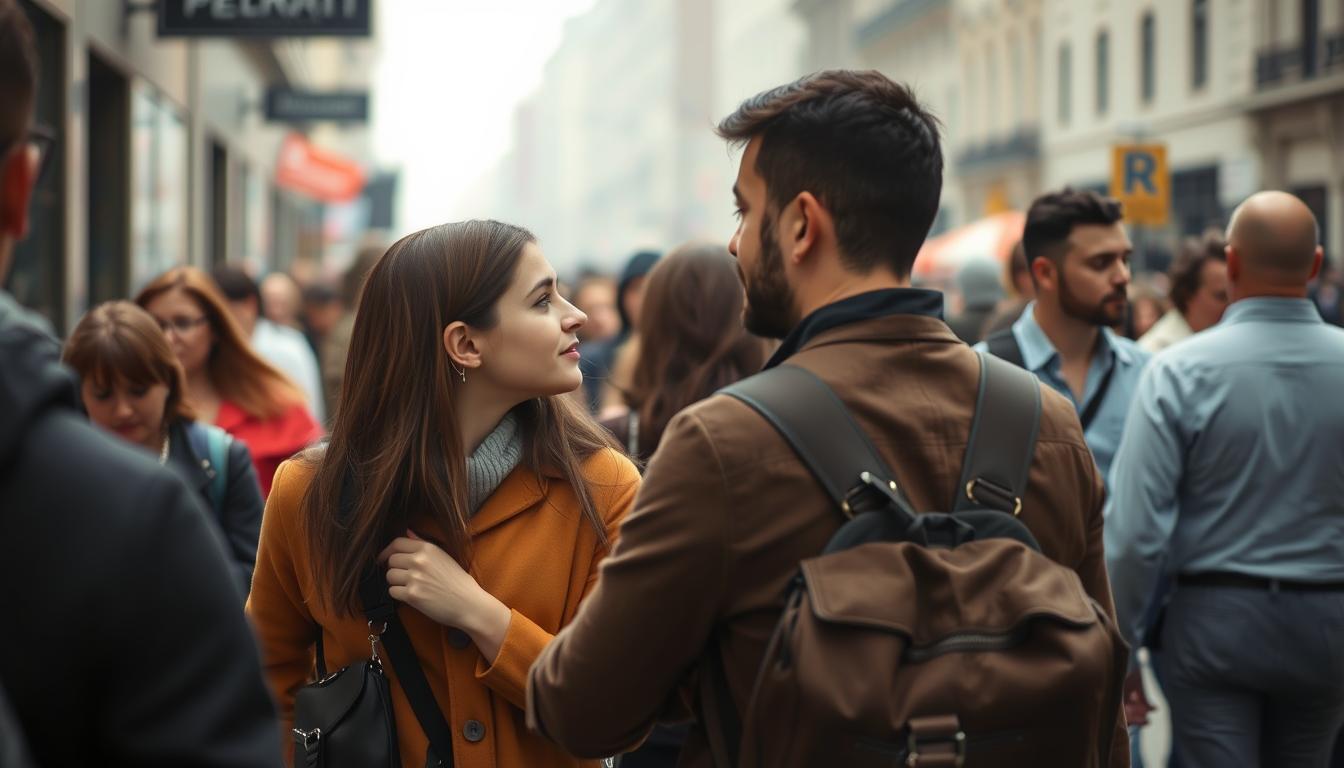
Every day, we meet strangers in brief moments. A smile on the street, a nod at a coffee shop, or a quick chat on a train. These moments can make a big impact. The song Passing Strangers by Ultravox, released on October 10, 1980, captures this idea.
It reached No. 82 in the U.S. Billboard charts and No. 57 in the UK. Its 1969 re-issue even climbed to No. 20 and stayed for 15 weeks. The song’s 3:48 runtime shows how a brief connection can last a long time.
Human connections can change our views on life. The track’s live B-side Face to Face, recorded in 1980, and its 1969 re-issue success show this. Russell Mulcahy directed its music video, capturing the essence of fleeting yet impactful interactions.
Why do some encounters stick with us? How do these connections shape us? This article looks into how brief encounters, like Ultravox’s 1980 hit, leave lasting marks. From chart-topping music to everyday moments, we see how these connections change lives.
The Beauty of Everyday Encounters
Everyday meetings with strangers have a special power. A smile from a neighbor or a laugh over spilled coffee can change our day. Even in busy cities like New York, these moments are important.
In New York, where 27,000 people live per square mile, we often meet others. These positive moments release oxytocin, making our daily tasks more enjoyable.
“Life seems to be getter a little better; there’s more blue sky and optimism recently. That is so good! But there is a lingering edge.”
E.B. White said 18 inches is the perfect distance for connecting with others. But during the pandemic, even that seemed too close. Yet, 100% of people say small moments have changed their view, with 75% saying it helped them grow.
These brief interactions, like a friendly grocery clerk, build our strength. A barista remembering your order or a stranger nodding at you can make us feel connected.
Even though loneliness is rising, these small interactions are key. They remind us that strangers can bring joy. A chance meeting can turn a simple walk into a memorable story.
Connecting Through Eye Contact
Eye contact is a silent bridge between strangers. A fleeting glance can spark a moment of connection. Even if people will never meet again, a look can make a difference.
Science shows that eye contact is powerful. It activates brain regions tied to reward, making brief exchanges feel uplifting. A 3–4-second gaze is just right—long enough to acknowledge someone without overstepping.

Cultural differences affect eye contact. In Western settings, people hold eye contact 61% of the time. But in other cultures, prolonged gazes might signal disrespect.
Events like Sydney’s Human Connection gatherings show curiosity can break barriers. Participants feel “seen” after just two minutes of mutual gazing. 40% of couples find strangers more relatable after eye contact.
Even a smile exchanged with a passerby can brighten our day. Modern life often replaces these moments with screens. But small choices, like meeting a neighbor’s gaze, can reignite human bonds.
Science and stories remind us: our eyes hold the power to transform ordinary encounters into profound, wordless dialogues.
Stories That Remain Untold
Every day, strangers passing by brush past us, each carrying untold stories. These stories are hinted at by their expressions or steps. The Prague Jewish cemetery, with 700 years of lives, is a silent graveyard.
Each weathered headstone hints at a life cut short. The Skeen family, for example, lost seven children in 1870. Their tragedies remind us how grief can fade from memory.
Human curiosity makes us wonder about the lives of passing characters. We create stories for the woman with the yellow scarf or the man looking at a bus schedule. Writers like Walt Whitman have done the same, turning brief glimpses into lasting art.
Even today, cities offer endless stories. But technology has changed how we see strangers. Social media makes some familiar, but most remain unknown. The Skeen family’s sorrow, like many others, shows the lasting impact of loss and isolation.
The Role of Technology in Strangers’ Interactions
Technology changes how we meet strangers, mixing old and new ways to connect. Smartphones and earbuds can make us less likely to talk to others. But apps like BlaBlaCar and dating apps connect millions every month. This shows how tech can help us meet new people.
A 2023 study at the University of Chicago found that tech can spark deep conversations. People talking to robots had 50% longer talks than those with posters. This shows tech can help us connect more deeply.
“The robot condition revealed participants asked more personal questions, like ‘What’s a risk you’d take for love?’ compared to superficial small talk,” noted the study.
Social media changes how we trust others. For example, BlaBlaCar’s 2 million users trust drivers based on app reviews. Researchers call this a “trust stack,” where we trust platforms first.
While tech takes the place of face-to-face talks, apps like Nextdoor or Meetup build local communities. But we check our phones 96 times a day, missing out on real moments. It’s important to use tech to enhance, not replace, human connection. As the study found, even a simple question can start a meaningful conversation.
Kindness from Strangers
“When people feel heightened fear and isolation, they react in ways they normally wouldn’t.”
Kindness from strangers can be as simple as holding a door or returning a pen. In 1994, a young man in a John Lewis store gave £40 to a mother who was struggling to buy gifts. This shows how small acts can make a big difference.
But, kindness isn’t always the same everywhere. In Rio de Janeiro, 100% of blind pedestrians got help, but in Kuala Lumpur, it was less than half the time. New York City was the least helpful in U.S. studies, but even there, a motorist helped a stranded couple on the M25, showing kindness can thrive in tough times.

Research shows that cities like Knoxville and San Jose have more random kindness. Even in busy places like Tokyo or London, people show unexpected generosity. The University of British Columbia found that people are more likely to return lost wallets than expected.
Finland has been the world’s happiest country for eight years, thanks to its culture of kindness. From holding doors to sharing directions, Finns show that small acts can make a big difference.
Kindness from strangers is not just random—it’s a lifeline. When a stranger helps us, it can make us feel less stressed and more happy. These moments remind us that strangers can become unexpected friends, showing kindness is a choice we can all make.
The Psychology of Stranger Encounters
Every day, strangers passing by trigger complex mental processes. Social psychology shows how brief moments, like a smile or a nod, affect our feelings and choices. Our brains quickly judge strangers, influenced by our instincts and social norms.
The amygdala, a part of our brain, plays a key role in these moments. It balances our fear with curiosity, making us cautious yet curious.
Research with 5,000 U.S. participants found that people rate strangers more positively if they think they’ll meet again. This shows human psychology values connections over being alone. Even short talks, like with a barista, can make us feel better and less lonely.
Harvard research by Nicholas Epley found that commuters who talked to strangers were happier than those who didn’t.
Small gestures with strangers, like greeting a neighbor or sharing an elevator, are important. These moments are not random; they help us feel connected. Studies show that diverse interactions, from coworkers to strangers, lead to better well-being. Even brief chats can spark curiosity and break down barriers.
Understanding these mechanisms helps us see strangers as opportunities for connection. Psychiatrist Dr. Maymunah Yusuf Kadiri says that varied social interactions are key to mental health. Every smile or glance is a chance to change how we interact with the world.
Navigating Urban Spaces
Urban interactions turn public spaces into stages for brief yet meaningful encounters. In Paris, streets are walkable on Sundays, thanks to wide sidewalks and mixed-use areas. This design choice boosts human connection.
“Walk appeal” in architecture and landscaping makes streets magnets for pedestrians. It encourages chance meetings.

Sociologist Erving Goffman’s “civil inattention” explains how city folks balance being aware and private. This balance is essential in crowded places. But, modern sprawl, which favors cars, reduces these chances.
Studies show that walkable neighborhoods build stronger social bonds. On the other hand, homogenized suburbs isolate people. Walkonomics data shows that short blocks and varied destinations, like Pamplona’s plazas, create better networks than Tucson’s car-focused layouts.
“Walkability isn’t just about movement—it’s a blueprint for community,” says urban planner Jeff Speck, whose 10 design principles prioritize human scale over vehicles.
Urban DMA (Density, Mix, Access) principles help planners create spaces where people linger and connect. As cities grow, finding the right balance between privacy and connection is vital for vibrant, inclusive communities.
Serendipity and Fortuitous Meetings
Strangers passing by might seem like fleeting moments, but they hold hidden value. Serendipitous meetings—those unplanned collisions with others—often spark life-changing turns. A study shows 75% of people find meaningful relationships through chance encounters, proving unexpected connections shape our paths.
Albert Einstein once said, “Coincidence is God’s way of remaining anonymous.” This idea plays out in our daily lives. Places like cafes or parks naturally bring people together. Steve Jobs designed Apple’s headquarters with a central atrium to encourage these chance meetings, knowing they spark innovation.
“Unexpected connections often feel like answers waiting to be noticed.”
Modern workplaces struggle with remote work, which reduces spontaneous exchanges. Yet, tools like Public Digital’s “random coffee” chats or Automattic’s P2 blogs help recreate serendipity online. These efforts mirror the University of Michigan’s Innovate Brew program, where cross-departmental conversations lead to breakthroughs.
Data shows 55% of career advancements come from informal interactions. Even small gestures—like starting a conversation on a train—can open doors. Embracing openness to strangers doesn’t mean ignoring caution, but staying curious. After all, 60% of friendships began with a glance or a shared moment, showing the world is full of hidden opportunities.
Cultivating Curiosity about Strangers
Every day, strangers passing by carry stories waiting to be noticed. Starting to be curious about people is as simple as pausing to look at their body language. Or asking questions that lead to meaningful dialogues. These moments need observation skills to understand the situation and respond genuinely.

Author and researcher Jane Smith spent 12 months traveling to practice “stranger curiosity.” Her work shows that even brief exchanges, like a smile or a shared observation, can dissolve social barriers. Psychologist Susan Fiske’s studies reveal how biases dim our empathy for those unlike us—yet curiosity can shift this. Imagine greeting a neighbor with, “What’s your favorite part of this neighborhood?” instead of avoiding eye contact.
“Face-to-face honesty needs courage,” says author Priya Parker, whose Together explores how curiosity builds bridges. “It’s not about invading privacy, but showing interest in shared humanity.”
Start small: Notice how people hold doors or interact with pets. Ask open-ended questions like, “What’s your go-to coffee order?” or “What’s one thing you’re grateful for today?” These can spark connections. Ethnographer Arnfjord’s Greenland research shows that even in remote communities, curiosity fosters mutual respect. Curiosity isn’t about interrogation—it’s a mindset that turns routine spaces into opportunities for discovery.
Practice observing without judgment. A coffee shop worker’s tired eyes might hint at a long shift; a child’s laughter could signal joy. These clues help us engage thoughtfully. Over time, this mindset turns public spaces into stages where human curiosity turns strangers into neighbors, one curious glance at a time.
Stranger Danger vs. Open-Mindedness
Teaching kids about safety considerations means finding a balance. The National Center for Missing & Exploited Children says most dangers come from people kids know, not strangers passing by. But, kids need to know how to protect themselves without being scared all the time.
The “no-go-tell” strategy is helpful. It tells kids to say no, leave, and tell someone if they feel scared. This way, they can act on their instincts when they sense danger.
“Safety isn’t about avoiding all strangers. It’s about knowing who to trust.”
It’s important to respect how different cultures view public interactions. In some places, saying hello to neighbors is common. In others, it’s best to keep to yourself. Parents should teach kids about these differences without making them too shy to make friends.
Lessons should match the child’s age. Young kids learn not to go anywhere with someone they don’t know. Older kids practice saying no to unsafe requests. They also learn to spot dangers, like someone trying to give them treats or asking for help.
Online safety is also key. Teens need to know how to spot scams or grooming attempts online. Talking about safety considerations and practicing scenarios helps them feel confident. The aim is to teach kids to be safe while also being open to kindness from people they can trust, like teachers or police.
Teaching that respects cultural differences and listens to kids’ instincts helps them grow strong. By focusing on behavior, not just who someone is, families can raise kids who are safe and socially aware. These kids will be ready to face the world’s challenges.
Embracing the Beauty of Transience
Strangers passing by often leave lasting impressions. A seatmate’s story or a traveler’s smile can spark meaningful moments. These moments shape our understanding of human connection.
Sylvie’s transient lifestyle shows us that impermanence can make life richer. Even brief exchanges, like those in Claire Millikin’s “Selfie in a Family of Campers,” reveal our shared search for belonging.
Transient relationships challenge us to live in the present. The Japanese concept of mono no aware teaches us to find grace in life’s fragility. Ellen Taylor’s “Homelands” contrasts fixed homes with nomadic journeys, showing us to balance roots with resilience.
Even small gestures, like a stranger’s kindness or a shared laugh, become anchors in our memories. They prove that lasting meaning doesn’t need permanence.
Modern life often values the enduring over the ephemeral. Yet, research shows mindfulness in everyday interactions boosts well-being. Temporary connections remind us that beauty lies in the moment itself.
Like the rivers in Ruth’s journey, we flow through encounters, carrying forward lessons without clinging to outcomes. These moments, brief as they are, weave our shared human tapestry.